The 80/20 Rule at Work: How to Find the Few Tasks That Actually Matter

Think back to your last really busy day. You answered messages, sat through a meeting, fixed a formatting problem, replied to a “quick question.” Now ask what you can actually point to at the end of it. For most of us the honest answer is: not much.
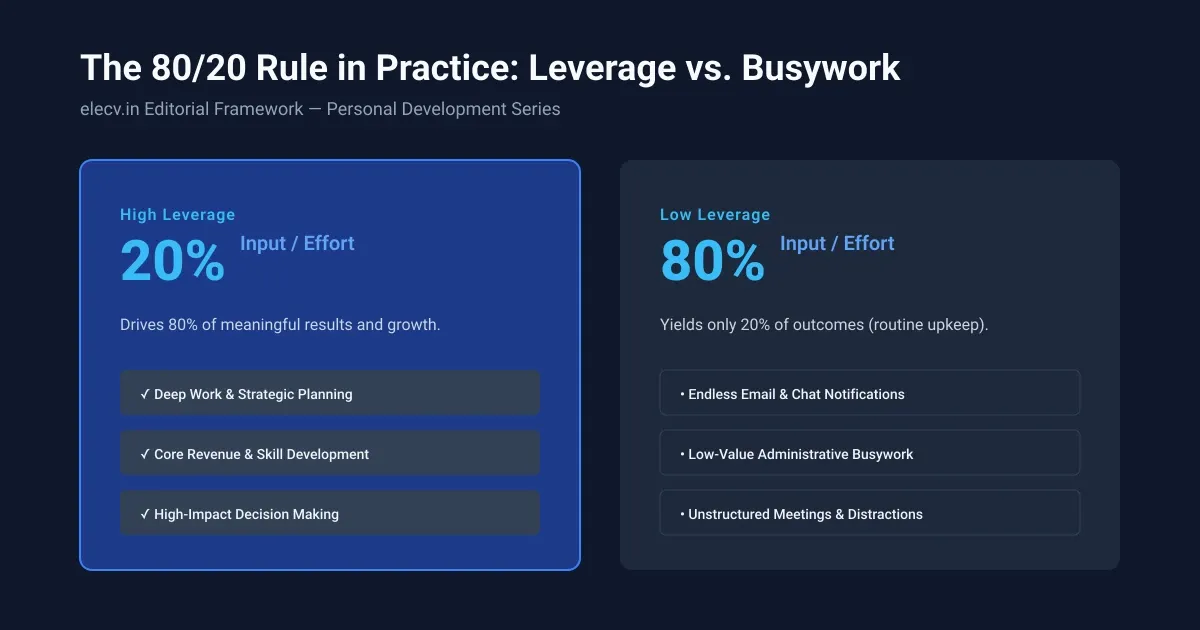
That gap between feeling busy and getting somewhere is what the 80/20 rule is about. Vilfredo Pareto, an Italian economist, noticed in the 1890s that about 80% of the land in Italy belonged to about 20% of the people. Later writers turned that into a rule of thumb: a small share of causes tends to produce most of the results. The numbers are never exactly 80 and 20. What matters is the lopsidedness. A few customers bring in most of the revenue. A few chapters of a textbook cover most of the exam. A few tasks in your week decide whether it was a good one.
This article shows how to use the Pareto Principle at work: a simple way to find those tasks in your own work, and what to do once you have.
Why a full to-do list works against you
Most to-do lists treat every item as equal. “Reply to Priya’s email” sits next to “write the proposal that could win the client,” and the email is easier, so it goes first. Ticking it off feels good. Repeat that ten times and the morning is gone.
Switching between tasks costs more than it seems. Researchers who study this (Sophie Leroy’s work on “attention residue” is the best-known) found that part of your mind stays on the previous task after you move to the next one. So checking a notification in the middle of a hard piece of work doesn’t cost you thirty seconds. It can cost you the next ten minutes of poor focus.
Step 1: Track one week, honestly
You can’t guess your way to the 20%. Memory flatters us: most people think they spend far more time on real work than they do.
For five working days, write down what you did in half-hour chunks. A notebook or a plain spreadsheet is enough. Next to each entry, add a few words on what came out of it: “draft of the Q4 report,” “nothing, mostly email.”
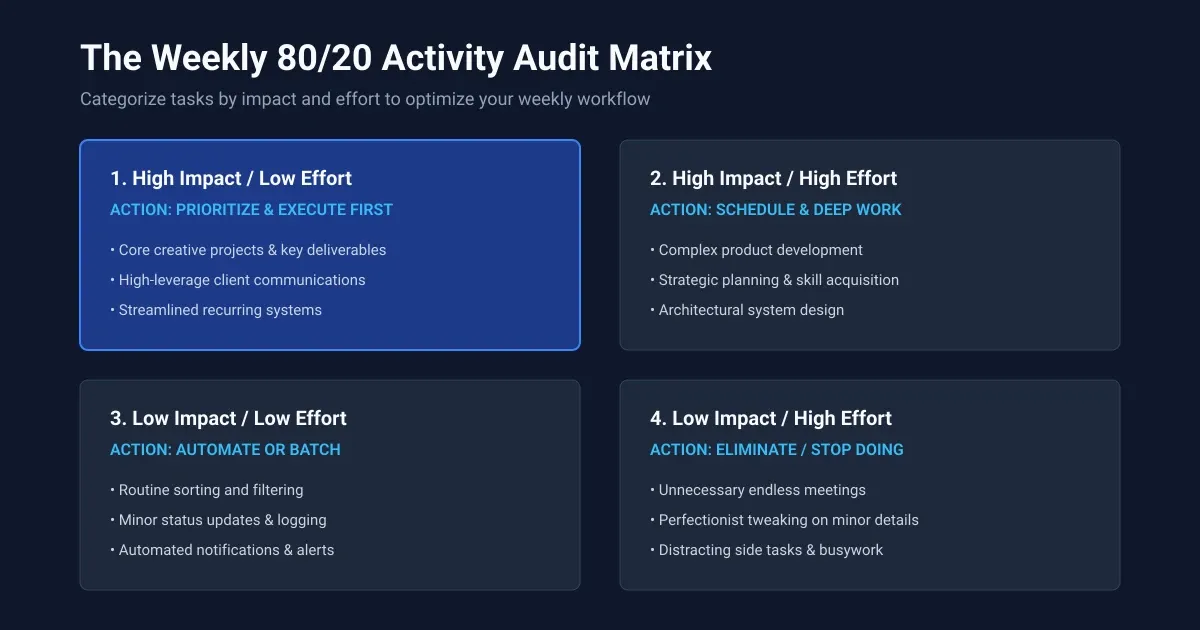
At the end of the week, go through the list and mark two things for each task:
- Did it move something that matters? A signed client, a finished chapter, a skill you’re building, a relationship you care about.
- Did it need me? Could someone else do it, could a template do it, or could it simply not happen?
Most people find the surprise is on the first question. A freelance designer, say, might discover that two of her eleven clients produce most of her income, while the three smallest eat a third of her week in revision requests. A student might find that the 40 minutes a day spent re-organising notes produced less than 20 minutes of practice questions. Your own numbers will differ. The point is to see them.
Step 2: Cut, automate, hand off
Once you can see the pattern, go through the low-value tasks in this order.
Stop doing it. Ask what would really happen if you dropped it. Recurring meetings with no agenda and reports nobody reads often survive on habit alone. Skip one and see who notices.
Automate it. If you’ve typed the same email reply five times, save it as a template. If scheduling takes six messages, use a booking link. These are small fixes, and over a year they add up to days.
Hand it off. If you work with others, pass on tasks that don’t need your particular skills. This isn’t dumping. It frees your best hours for the work only you can do.
Keep the rest, but shrink it. Some admin has to happen. Batch it into one slot, say 4 p.m., instead of letting it leak into the whole day.
Step 3: Protect the 20%
Knowing the important work doesn’t help if it only gets the leftovers. A few habits that make it stick:
- Pick one task each morning. Not five. The single thing that would make the day a success even if everything else slipped. Do it before you open email or chat.
- Block 90 to 120 minutes. Put it in your calendar like a meeting. Phone in another room, notifications off.
- Spend five minutes at the end of the day. Write down what got done and what tomorrow’s one task is. It saves the morning from a pile of decisions.
If your job is reactive, as in support or operations, you can’t ignore the inbox. But you can check it at set times (say 10, 1 and 4) instead of on every ping, and most people find nothing breaks.
If the work you are protecting is studying rather than a job, the 30-day study routine shows how to start with ten minutes a day.
If you want a ready-made system
Some people prefer to follow a structured programme rather than build their own from a notebook. One option we came across is the 80/20 Productivity System, a paid course on focus and time management. We haven’t taken the course ourselves, so we can’t tell you how good it is.
Here is what we can say from its public product page, as we read it on 16 November 2026:
- It was listed at $297 as a one-time price, which is a lot for a productivity course. Everything in this article you can do for free.
- The page mentions bonuses and a money-back guarantee, but didn’t state how many days the guarantee runs.
- Its sales copy makes big claims about hours saved. We’d treat those as marketing, not as results you should expect.
If you do consider it, read the current price, what’s included and the refund terms on the seller’s own page first. And whatever system you choose, the test is the same: if it takes more time to maintain than the work it organises, you’ll drop it within a month.
A clutter-free workspace helps too; try this three-step desk cable fix. Long focus blocks are easier to sit through at a sensible desk, so see what a laptop stand can and cannot fix.
Common questions
How do I prioritise tasks at work?
Sort the week’s tasks by impact and effort, as in Step 1. Do the high-impact ones first, schedule the rest, and drop what doesn’t pay off.
How do I know if a task is high-leverage?
Ask: if this were the only thing I finished today, would the day still count? If yes, it’s in your top 20%.
Does the 80/20 rule really mean exactly 80 and 20?
No. It’s a rule of thumb about uneven results. Sometimes it’s 90/10, sometimes 70/30. The useful habit is asking “which few things are doing most of the work?”
Can I use it outside work?
Yes. A few habits, like sleep, regular movement and planning your week, tend to do more for how you feel than dozens of smaller tweaks. Start with those before trying anything new. The same idea works in a garden: start small and check sun, soil and water first. More habit-focused guides are collected under Personal development.
More in Personal development
- Personal development
How to Build a Study Routine That Lasts: A Simple 30-Day Plan
A simple 30-day plan for a study routine that lasts: start with ten minutes, anchor it to your day, track one line, and restart fast after a missed day.